Safety
Laser Safety
The Center for Devices and Radiological Health (CDRH) was established in October 1982, by the U.S. Food and Drug Administration (FDA) to protect the public health in the fields of medical devices and radiological health
Manufacturers of products subject to performance standards under the Radiation Control for Health and Safety Act of 1968 are required to furnish various reports to the CDRH.
The Odyssey DLx is certified as a Class I laser product. This means that hazardous laser radiation is not emitted outside the instrument. Radiation emitted inside the Odyssey DLx is confined within protective housings and external covers. A series of safety interlocks ensures that the laser beam cannot escape during any phase of user operation.
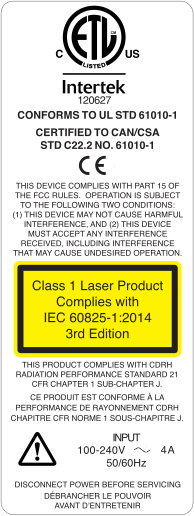
The CDRH implemented regulations for laser products on August 1, 1976 (CDRH radiation performance standard 21, Code of Federal Regulations Chapter 1, Subchapter J). Compliance for products marketed in the United States is mandatory. The label that must be attached to laser products marketed in the United States is illustrated in Figure 57 and is located on the rear panel of the Odyssey® DLx, indicating compliance with CDRH regulations.
WARNING: Use of controls or adjustments or performance of procedures other than those specified herein may result in hazardous radiation exposure.
AVERTISSEMENT: L'utilisation des commandes ou le réglage ou la performance des procédures autrement qu'il a été indiqué dams le présent texte peut résulter en de dangereuses expositions aux radiations.
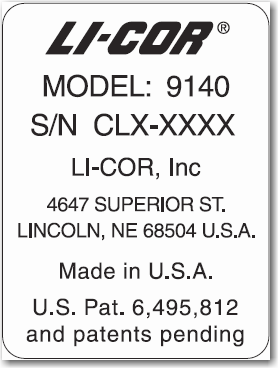
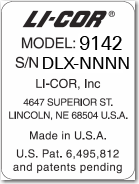
The manufacturer label is illustrated in and is also on the rear panel of the instrument.
The Odyssey DLx Infrared Imaging System contains two lasers; one emitting at 785 nm, and one at 685 nm. The 685 nm laser emits visible laser radiation - direct exposure to either beam may cause eye damage. Laser radiation is emitted through apertures at the top of the Odyssey DLx microscope assembly. Because the microscope assembly moves in both planes relative to the glass scanning surface, laser radiation could be focused at any position on this surface. Safety interlocks (described below) automatically turn the lasers off when the Odyssey DLx lid is opened.
The label shown in Figure 58 is affixed to the inside of the Odyssey DLx case at two locations; one near the laser/microscope assembly scanning bed, and the second on the cover that is used to seal the above mentioned assembly.
|
|
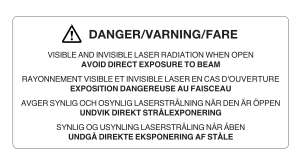
See System Overview for the location of the labels in and Figure 57. The label in Figure 58 is affixed to the inside of the Odyssey® DLx Imager case at two locations; one near the laser/microscope assembly scanning bed, and the second on the cover that is used to seal the above mentioned assembly.
Safety Interlocks
The Odyssey DLx has two safety interlocks that prevent access to the laser when the instrument lid is opened during operation.
Chemical Safety
LICORbio recommends that all biochemicals be handled carefully, and that safe laboratory procedures be followed at all times. Be aware of the hazards associated with any chemical before you begin work.
The LI‑COR Odyssey DLx should not be used with any radioactive materials.